
Kenyan Sand Boa Care Guide: Enclosure, Morphs, Feeding, Breeding & Everything I’ve Learned After Years of Keeping These Tiny Burrowers (2026)
I’ll be honest—the first time I saw a Kenyan sand boa at a reptile show, I walked right past the table. It was a plain brownish-orange sausage with tiny eyes and a blunt tail that I mistook for a deformed snake. Not exactly a showstopper. Then the breeder picked one up, and it burrowed between his fingers like it was tunneling through sand, poking its little head out with the most ridiculous, derpy expression. I was completely charmed. I bought a pair that day, and within a year, I had a rack full of them. Within two years, I was producing babies and wondering why I’d ever overlooked these perfect little serpents.
Since then, I’ve raised more Kenyan sand boas than I can easily count. I’ve produced anery stripes, snows, paradox albinos, and good old normals with the sweetest temperaments. I’ve made mistakes—overfeeding, wrong substrate choices, humidity missteps—and I’ve learned from every single one. What strikes me most about this species is how easy they seem on the surface, and how many keepers mess up the details because they treat them like a disposable beginner pet. They’re forgiving, yes, but they’re also living animals that thrive when you respect their unique biology.
This guide is everything I know about keeping, breeding, and appreciating Kenyan sand boas. Whether you’re researching your first snake or adding to a growing collection, I want to give you the deep-dive I wish I’d had when that little sausage first burrowed into my heart.
Quick Facts / Snapshot
| Category | Detail |
|---|---|
| Scientific name | Eryx colubrinus (sometimes still sold as Gongylophis colubrinus) |
| Common name | Kenyan sand boa, East African sand boa |
| Origin | Arid and semi-arid regions of East Africa (Kenya, Tanzania, Ethiopia, Egypt) |
| Adult size | Females 24–32 inches, 400–900g; males 15–20 inches, 70–150g |
| Lifespan | 15–20+ years in captivity; some documented past 25 |
| Temperament | Docile, slow-moving, rarely bites; excellent for handling |
| Activity pattern | Crepuscular and nocturnal; spends most time buried |
| Difficulty level | Beginner to intermediate (hardy, but specific substrate and humidity needs) |
| Price range (2026) | $50–$100 for normals; $150–$500+ for morphs; $1,000+ for rare combos |
| Special traits | Burrowing species; blunt tail mimics head (caudal luring); heavy-bodied |
That size difference between males and females is extreme. I’ve had females that weighed over 800 grams and stretched nearly three feet, while their brothers fit comfortably in the palm of my hand. We’ll talk about why that matters for housing and breeding.
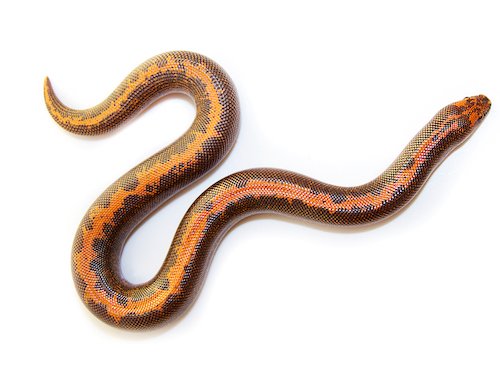
Kenyan Sand Boa For Sale (captive-bred babies)
We have some amazing Kenyan Sand boas for sale. These are some of the most popular pet snakes in the world, and for good reason. This is because these snakes rarely grow longer than two-feet, are simple to maintain in captivity, and are generally quite handleable. When you buy a boa from us, you automatically receive our 100% live arrival guarantee.
What Is a Kenyan Sand Boa?
The Kenyan sand boa is a small, stout-bodied constrictor adapted for a life spent mostly underground. In the wild, they inhabit dry savannas, scrubland, and desert fringes, where they burrow into loose soil and sand to escape the heat and ambush prey. They’re part of the boa family—yes, they’re true boas, just miniature and ground-dwelling—and like all boas, they give live birth rather than laying eggs.
I’ve watched mine for countless hours (or at least, the parts of them that are visible above the substrate). They’re ambush predators to the core. A Kenyan sand boa will bury itself with only its eyes and snout exposed, wait motionless for a lizard or small rodent to wander past, and strike with surprising speed. That blunt tail that looks like a head? It’s not just a funny quirk. They use it as a caudal lure, waving it slowly to attract curious prey while the real head stays hidden and ready. I’ve seen babies do this instinctively in their deli cups—it’s remarkable to watch.
In captivity, they retain all those instincts. They need to burrow. A sand boa kept on paper towels or a hard surface is a stressed sand boa. I’ve seen them refuse food, pace the enclosure, and develop skin issues when denied proper substrate. Understanding this one fact—that they are fossorial, not just surface-dwellers—unlocks everything about their care.
Understanding Size and Sexual Dimorphism
The size gap between male and female Kenyan sand boas is one of the most dramatic in the snake world. I always warn new keepers: if you’re buying a baby, you need to know the sex because it completely changes what you’re signing up for.
Typical Growth Chart (Captive-Raised, Well-Fed)
| Age | Female Size & Weight | Male Size & Weight |
|---|---|---|
| Hatchling | 6–10 inches, 8–15g | 5–8 inches, 5–10g |
| 6 months | 14–18 inches, 50–100g | 10–13 inches, 20–35g |
| 1 year | 18–22 inches, 150–300g | 12–15 inches, 40–70g |
| 2 years | 22–28 inches, 300–600g | 14–18 inches, 60–100g |
| 3 years+ | 24–32 inches, 500–900g+ | 15–20 inches, 70–150g |
I’ve had a 5-year-old female push past 900 grams—she’s a thick, muscular snake that needs two hands to hold securely. Her male counterpart from the same clutch weighs 120 grams soaking wet and could coil up on a coaster. This isn’t abnormal. It’s the blueprint of the species.
Why does this matter? Because enclosure size, prey size, and even handling technique change based on sex. A male might live happily in a 10-gallon tank his whole life. A large female needs a 20-gallon long or larger. If you’re not sure what you’ve got, get a reputable breeder or vet to probe or pop (gently, and only if trained).
Lifespan & The Commitment
A Kenyan sand boa can live 15 to 20 years with proper care, and I know keepers with individuals pushing 25. That’s not as epic as a tortoise or a parrot, but it’s still a long time. I’ve taken in rescues that were 12 years old and still going strong after years of suboptimal care, which tells you how tough these snakes can be.
I’ve also seen them die young from preventable causes—impaction from sand ingestion, chronic dehydration, overheating. They’re hardy, but they’re not immortal. If you’re bringing home a Kenyan sand boa, plan on two decades of frozen mice, substrate changes, and vet access. That’s a good thing. It’s a long, low-maintenance companionship if you do it right.
Is a Kenyan Sand Boa Right for You?
I recommend Kenyan sand boas more often than almost any other snake to new keepers—with caveats. Here’s my honest breakdown.
The Pros
- Incredibly docile. I’ve handled hundreds of sand boas, and I can count the number of bites on one hand. Most would rather burrow into your palm than strike. They’re slow, deliberate, and very tolerant.
- Manageable size. Even the biggest females are handleable by one person. Males are tiny. No need for giant enclosures.
- Simple heating and lighting needs. No UVB required. A heat mat and thermostat can handle the basics.
- Fascinating behaviors. Watching them burrow, poke their heads out, and ambush prey never gets old.
- They’re great eaters (usually). Once established, Kenyan sand boas are garbage disposals for frozen-thawed mice. I rarely deal with fasting issues.
- Wide variety of morphs. From albinos to snows to stripes, there’s a color for every taste without breaking the bank.
The Cons
- They hide all day. If you want a display snake that’s always visible, get a corn snake. A sand boa is a box of substrate with occasional snout poking out. I find it delightful; some people find it boring.
- Substrate matters. You can’t just throw them on aspen and call it a day. The wrong substrate can cause impaction, respiratory issues, or shedding problems.
- Live birth (for breeders). If you breed them, you’re dealing with baby boas, not eggs. That can catch new breeders off guard. Also, the babies are tiny.
- Sexing can be tricky. Mis-sexed babies are common in the pet trade. If you buy a “male” from an unreliable source and it turns into an 800-gram female, your setup might be suddenly wrong.
- Feeding response can be startling. When they do strike, it’s fast and hard. I’ve seen keepers drop their snake from surprise.
Who Should NOT Get a Kenyan Sand Boa
- Someone who wants a display animal they can watch all day.
- Someone unwilling to research and provide appropriate burrowing substrate.
- Someone who expects a large, impressive snake. Even big females are manageable.
- Someone who doesn’t want to handle frozen rodents.
For almost everyone else—especially apartment dwellers, first-time snake owners, and keepers who appreciate quirky natural behaviors—a Kenyan sand boa is a stellar choice.
Enclosure & Housing Requirements
I’ve set up Kenyan sand boas in everything from plastic tubs to naturalistic desert vivariums, and I’ve learned what works and what causes problems.
Enclosure Size
| Snake Size | Minimum Enclosure | Ideal Enclosure |
|---|---|---|
| Hatchling | 6-quart plastic tub (12×8×4) | 12-quart tub or 5-gallon tank |
| Juvenile male | 10-gallon (20×10×12) | Same or 15-quart tub |
| Adult male | 10-gallon (20×10×12) | 32-quart tub or 15-gallon |
| Juvenile female | 15–20-gallon long | 20-gallon long (30×12×12) |
| Adult female | 20-gallon long (30×12×12) | 40-gallon breeder (36×18×16) |
I keep most of my adult males in 32-quart rack tubs and adult females in 41-quart tubs or 20-gallon longs. The key is floor space, not height. A Kenyan sand boa doesn’t climb. It burrows. A tall tank is wasted space and makes heating harder.
Substrate: The Most Important Decision
This is where I see the most mistakes. A sand boa needs a substrate that allows easy burrowing, holds a bit of moisture without being wet, and won’t cause impaction if accidentally ingested. After trying many options, here’s what I’ve landed on:
My preferred substrate: I use a mix of Zoo Med Aspen Snake Bedding (shredded aspen) as the primary material, layered 3–5 inches deep. Aspen is soft, holds tunnels well, and is digestible in small amounts. I’ve never had an impaction from aspen ingestion. For a more naturalistic setup, I’ll mix in organic topsoil and play sand (70/30 ratio), but this requires more maintenance and drying out to prevent humidity spikes.
What I avoid:
- Pure calcium sand or fine play sand as sole substrate. It’s heavy, doesn’t hold burrows well, and can cause impaction if ingested in large quantities. I’ve seen sand boas kept on pure sand develop intestinal blockages.
- Cedar, pine, or other aromatic woods. Toxic to reptiles.
- Coconut coir alone. It holds too much humidity for an arid species unless carefully managed and dried.
- Reptile carpet or paper towels long-term. They don’t allow burrowing, which is a fundamental need.
I provide a moist hide—a small container with damp sphagnum moss or moist coco coir—on one side of the enclosure. This is especially important during shedding. The rest of the substrate stays dry on the surface with a slight humidity gradient below.
Heating and Temperature
Kenyan sand boas need belly heat for digestion and a thermal gradient to thermoregulate. I use an under-tank heat mat (UTH) on a thermostat, placed under one-third of the enclosure floor. Never use a heat mat without a thermostat—I’ve treated burns on rescues, and it’s ugly.
| Parameter | Target |
|---|---|
| Basking surface temp (above heat mat) | 90–95°F |
| Warm side ambient | 85–90°F |
| Cool side ambient | 75–80°F |
| Night temperature | Can drop to 70–75°F safely |
I measure temperatures with a digital temperature gun and a digital probe thermometer. The snake should be able to choose between warm and cool zones by moving within the substrate. They’ll often burrow down to the warm side after eating, then shift to the cooler area for a few days.
Lighting: I don’t use UVB for sand boas, and I don’t think it’s necessary. If you want to provide a low-level UVB for a naturalistic setup, that’s fine as long as there are shaded retreats. A simple LED or low-wattage daylight bulb on a timer helps establish a day/night cycle, which I do use.
Humidity and Hydration
An arid species doesn’t mean zero humidity. I keep ambient humidity around 30–50%, with a moist hide providing a localized spike. I mist the moist hide as needed, not the whole enclosure. A water dish with fresh water is always available—small and shallow so the snake can drink without soaking constantly. I’ve seen sand boas develop scale rot when forced to sit in damp substrate, so I keep the main substrate dry.
Decor and Enrichment
- Hides: At least one hide on the warm side and one on the cool side, even though they spend most time buried. I use cork flats, half-logs, or plastic hides partially embedded in the substrate.
- Branches and rocks: Not necessary, but I’ve found that sturdy, flat rocks on the warm side give them a basking surface they’ll occasionally use.
- Plants: If using a naturalistic setup, drought-tolerant succulents or air plants can be added, but they’ll get bulldozed by an enthusiastic burrower.
Diet & Feeding
Kenyan sand boas are rodent-eaters, and in my experience, they’re some of the most reliable feeders in the snake world—once they get going.
Feeding Schedule
| Age / Size | Prey Type | Frequency |
|---|---|---|
| Hatchling (first meals) | Live pinky mouse (first feed or two); transition to frozen-thawed pinkies | Every 5 days |
| Juvenile (small) | Frozen-thawed pinkies or fuzzies | Every 5–7 days |
| Subadult male | Fuzzy or small hopper mouse | Every 7 days |
| Adult male | Hopper or small adult mouse | Every 7–10 days |
| Subadult female | Hopper to small adult mouse | Every 7 days |
| Adult female | Small to medium adult mouse; occasionally a rat pup | Every 10–14 days |
Prey size rule: The mouse should be roughly the same width as the thickest part of the snake’s body. Kenyan sand boas have slower metabolisms than colubrids, so I err on the side of smaller, less frequent meals. Overfeeding leads to obesity, especially in females, which I’ve seen shorten lifespans and cause reproductive problems.
Feeding Tips I’ve Learned
- Feed in the enclosure. Moving a sand boa to a separate container causes stress and can lead to refusal. I’ve never had a substrate ingestion issue doing this.
- Use tongs. Their feeding response is a lightning-fast strike from below the substrate. Your fingers look like pinkies.
- Transitioning from live to frozen-thawed: I start babies on live pinkies (they can’t hurt the snake), then gradually switch to pre-killed, then frozen-thawed. Scenting with lizard scent or braining may help stubborn individuals.
- Night feeding works best. I feed in the evening when they’re more active and in ambush mode.
- Don’t handle after feeding. Give them 48 hours to digest.
Water
Always available. I use a small, heavy ceramic water dish that won’t tip over when the snake bulldozes through the substrate. Change daily. I’ve caught my sand boas drinking in the early morning hours.
Health, Common Problems & Vet Care
Kenyan sand boas are generally healthy, but I’ve dealt with a few specific issues over the years.
Regurgitation
I’ve seen this when temperatures are too low, prey is too large, or the snake is handled too soon after eating. If a snake regurgitates, I wait a full two weeks before offering a smaller meal and check temperatures immediately. Repeated regurgitation is a vet-visit situation.
Respiratory Infections
Uncommon in properly set up sand boas, but I’ve seen it when humidity is too high and ventilation is poor. Signs: wheezing, bubbles from nostrils, open-mouth breathing. Fix the environment first, then vet if needed.
Impaction
This is the boogeyman of sand boa keeping. I’ve seen one impaction case in a rescue kept on pure calcium sand. The snake was lethargic, constipated, and needed veterinary intervention. Avoid fine, ingestible sands; use aspen or a safe soil mix instead.
Stuck Shed and Eye Caps
Low humidity leads to patchy sheds. I provide a moist hide at all times, and if a shed is stuck, I soak the snake in shallow lukewarm water for 20–30 minutes, then gently assist removal with a damp cloth. I never pull stuck eye caps—vet if they persist after a soak.
Obesity
I see this in captive females all the time. A sand boa should be a rounded triangle in cross-section, not a perfect circle. If there are fat rolls when the snake curves, cut back on prey size and frequency. I feed adult females every 14 days, sometimes less.
Parasites
I quarantine all new arrivals for 90 days and get fecals done. Mites are rare on sand boas because they burrow, but I’ve seen them on newly acquired animals. Treat with reptile-safe mite products and complete enclosure disinfection.
Annual Vet Cost
A checkup and fecal run $75–$150. Emergency surgery for impaction or egg-binding (yes, they’re live-bearers, but dystocia happens) can cost $500–$1,500+. Budget accordingly.
Behavior, Temperament & Handling
I tell people that a Kenyan sand boa has the temperament of a warm, slow-moving scarf. They’re not fast. They’re not jumpy. They don’t musk or tail-rattle. When I handle mine, they gently explore, burrow between my fingers, and occasionally poke their head up to survey the situation. It’s incredibly calming.
A few handling guidelines:
- Let them settle in for a week before handling.
- Start slow—5 minutes, then 10, building up.
- Support their body. They’re heavy for their length and can fall.
- Watch for stress signs. If the snake is rigid, breathing rapidly, or striking, it’s done. Put it back.
- Don’t handle during shed or for 48 hours after feeding.
I’ve handled sand boas with children (supervised) and they’ve been perfect ambassadors. The only “aggression” I’ve seen is a feeding response—and that’s on me for smelling like mice.
Popular Kenyan Sand Boa Morphs
The morph market for Kenyan sand boas has exploded since I started. Here’s what I see most often:
| Morph | Description | Price Range (2026) |
|---|---|---|
| Normal / Wild-type | Orange-brown with dark blotches | $50–$100 |
| Albino | Bright orange and white with pink eyes | $100–$200 |
| Anerythristic (Anery) | Black, grey, and white; no orange | $100–$250 |
| Snow (Albino + Anery) | White with pale yellow pattern | $200–$500 |
| Stripe | Pattern reduced to a dorsal stripe | $150–$400 |
| Paradox Albino | Albino with scattered black pigment spots | $300–$1,000+ |
| Nuclear | Intense orange and clean pattern | $300–$800 |
| Dodoma locality | Distinct pattern, often darker | $100–$300 |
I’ve worked with most of these, and my personal favorites are the paradox albinos—each one is completely unique, like a living art piece. But a normal Kenyan sand boa is just as rewarding to keep.
Full Cost Breakdown (2026)
| Category | Cost Range |
|---|---|
| Purchase price (normal) | $50–$100 |
| Purchase price (morph) | $150–$1,000+ |
| Enclosure + lid | $30–$100 |
| Under-tank heat mat | $20–$40 |
| Thermostat | $30–$80 |
| Substrate, hides, water dish | $30–$60 |
| Temp gun / thermometer | $15–$30 |
| Frozen mice (annual) | $80–$150 |
| Substrate replacement (annual) | $50–$100 |
| Vet fund (annual) | $100–$300 |
| Total first-year cost | $355–$1,960+ (depending on morph) |
| Annual cost thereafter | $230–$550 |
A normal Kenyan sand boa is one of the most affordable pet snakes you can own long-term.
Breeding Kenyan Sand Boas
Breeding sand boas is straightforward but different from egg-layers. I’ve been doing it for years.
- Sexual maturity: Males at 12–18 months; females at 2–3 years and 300+ grams.
- Brumation: I cool to 70–75°F for 6–8 weeks in winter, stop feeding, and then gradually warm them up in spring.
- Mating: Introduce the male; he’ll pursue the female. Watch for combat.
- Gestation: 4–5 months. Females bask more and may refuse food late in pregnancy.
- Birth: 6–20 live babies, each in a sac they break free from. I remove babies immediately and set them up individually.
- Baby care: Start on live pinkies, then switch to frozen-thawed. I keep babies on moist paper towels initially to monitor health, then move to aspen.
I don’t recommend casual breeding. There’s a market, but do it ethically, with healthy animals and a plan for offspring.
Frequently Asked Questions
Q: What is a Kenyan sand boa?
A small, burrowing boa species from East Africa, known for its docile temperament, stout body, and the blunt tail that mimics its head.
Q: How big do Kenyan sand boas get?
Females reach 24–32 inches; males stay at 15–20 inches. Females are significantly heavier.
Q: How long do Kenyan sand boas live?
15–20 years, with proper care.
Q: What substrate is best for a Kenyan sand boa?
Shredded aspen is the most popular and safe choice. A soil/sand mix can work if managed carefully. Provide a moist hide for shedding.
Q: Do Kenyan sand boas need UVB?
No, they don’t require UVB. They’re nocturnal and fossorial.
Q: How often do Kenyan sand boas eat?
Hatchlings every 5 days, adults every 7–14 days, depending on size and prey.
Q: Are Kenyan sand boas good for beginners?
Yes. They’re docile, hardy, and easy to feed, making them excellent first snakes.
Q: Can I keep two Kenyan sand boas together?
No. They’re solitary and cohabitation can cause stress and competition.
Q: Do Kenyan sand boas bite?
Rarely defensively. Their feeding response is strong, so use tongs. A bite is startling but not painful.
Final Thoughts
I’ve kept a lot of snakes over the years, and I keep coming back to Kenyan sand boas. They’re not flashy. They’re not active. They spend 90% of their time buried in aspen like little subterranean submarines. But that 10%—when they poke their heads out, when they wrap gently around your wrist, when a baby sand boa burrows into your palm for the first time—makes them one of the most endearing reptiles in the hobby.
If you’re looking for a snake that’s manageable, forgiving, and quietly fascinating, you could do a whole lot worse than a Kenyan sand boa. Set them up right, feed them appropriately, and you’ll have a companion for two decades. Not bad for a derpy sausage with a fake head.