
Palmetto Corn Snake Care Guide: Morph, Genetics, Enclosure, Diet & Everything I’ve Learned After Years of Breeding Them (2026)
I’ll never forget the first time I saw a palmetto corn snake in person. It was at a breeder’s table at a reptile expo, and honestly, I stopped dead in my tracks. The snake was this creamy white canvas splattered with flecks of red, orange, and brown—like someone had flicked a paintbrush at a white wall. But it was the eyes that got me. Dark, round, almost cartoonish. I’d been breeding corn snakes for well over a decade at that point, producing lavenders, charcoals, tesseras, you name it. But the palmetto corn snake? It felt like a completely different species. I had to have one. I had to figure them out.
That was years ago now, and since then I’ve hatched more clutches of palmetto combos than I can easily count. I’ve made mistakes, lost a few babies to kinking issues that taught me hard genetic lessons, and produced some absolutely jaw-dropping animals that made it all worth it. Along the way, I’ve fielded hundreds of questions from people who saw a palmetto on Instagram and fell in love without knowing much about corn snake care, let alone the quirks of this particular morph.
This guide is everything I wish someone had told me when I bought my first pair of het palmetto corn snakes. I’m going to walk you through what makes this morph so special, how to care for them properly, what to watch for with the genetics, and why—despite their stunning looks—they might or might not be the right snake for you. No sugar-coating, no textbook fluff. Just real talk from someone who’s raised these animals from egg to breeding adult.
Quick Facts / Snapshot
| Category | Detail |
|---|---|
| Scientific name | Pantherophis guttatus |
| Common name | Palmetto corn snake (also known as palmetto morph) |
| Morph type | Incomplete dominant leucistic with variable pigment flecking |
| Adult size | 3.5–5 feet, occasionally larger females up to 5.5 feet |
| Lifespan | 15–20+ years in captivity with good care |
| Difficulty level | Beginner-friendly in terms of care; intermediate for genetics/breeding |
| Temperament | Docile, curious, excellent handling snake |
| Price range (2026) | $400–$800 for a typical palmetto; $1,000–$3,000+ for high-expression or combo morphs |
| Unique traits | White base color with random colored speckles; dark “bug eyes” common; genetically distinct from other leucistic lines |
If that price tag made your eyebrows rise, there’s a reason. The palmetto corn snake isn’t just a pretty face—it’s a relatively new morph with fascinating genetics that took the corn snake world by storm. I’ll break down exactly what you’re paying for.
What Is a Palmetto Corn Snake?
The palmetto corn snake is a color morph of the common corn snake, first discovered in the wild in South Carolina in 2012. The original animal was a single male found by a collector who recognized immediately that this wasn’t a run-of-the-mill amelanistic or snow corn. This snake was almost entirely white, with a few tiny dark flecks scattered across its body and big, dark eyes that looked nothing like the red eyes of an albino. A lab analysis confirmed it was a new type of leucism.
I got into the palmetto game a few years after that initial discovery, when the first few generations of captive-bred babies started trickling onto the market. The prices back then were astronomical—I remember seeing a hatchling palmetto corn snake listed for $4,000 and thinking the breeder was insane. In hindsight, given the years of proving out the genetics, that wasn’t unreasonable.
From a breeder’s perspective, what makes the palmetto corn snake so exciting is that the mutation is incomplete dominant. That’s different from the simple recessive traits most corn snake morphs follow. If you breed a visual palmetto to a normal corn snake, you don’t get all normals het for palmetto. You get a clutch full of “het palmetto” offspring that are visually different—they show a partial expression of the trait. I’ll get into the genetics later, because it’s a rabbit hole worth going down if you’re thinking about breeding.
Visually, a palmetto corn snake looks like someone erased most of the pattern and color, then sprinkled back random bits of pigment. No two are exactly alike. Some are heavily speckled with reds, oranges, and browns; others are almost pure white with just a few flecks. The eyes are large, dark, and expressive—often described as “bug eyes” because they protrude slightly more than a normal corn snake’s. This isn’t a defect in most lines, just a physical trait linked to the mutation.
The Palmetto Morph: Appearance, Variation & “Bug Eyes”
Let’s talk about what you’re actually going to see when you look at a palmetto corn snake, because I’ve had people buy one online and then email me asking if something is wrong with their snake’s eyes.
The Base Color
A palmetto corn snake’s ground color is white to off-white, sometimes with a faint pinkish or cream cast, especially in younger animals. As they mature, the white tends to brighten. The scales have a smooth, almost porcelain quality, which makes those colored speckles pop even more.
The Flecking / Speckling
This is where things get interesting. The “palmetto pattern” is random. I’ve hatched babies from the same clutch where one had heavy orange and brown speckling that looked like cinnamon toast, and its sibling was nearly pure white with three tiny red dots. The amount of flecking can shift slightly as they age—some develop more spots over time, others seem to lose a few. I’ve noticed that temperature during incubation might influence speckling density, but honestly, there’s still a lot of randomness involved.
What I find charming is that these speckles often cluster near the spine or along the sides in a way that mimics the ghost of a normal corn snake pattern. Some keepers call this “ghost patterning,” and it’s one of those subtle details that make palmetto corn snakes so visually addictive.
The Eyes
The “bug eye” look is common in palmetto corn snakes. The eyes are proportionally larger and slightly more bulbous than a wild-type corn snake’s, with a dark iris and pupil. I’ve seen a few with mildly asymmetrical eyes, and in extreme cases, the bulge can be pronounced enough to cause issues with closing the spectacles properly. That’s rare. In my collection, most palmetto corn snakes have perfectly functional eyes and eat without any trouble. But I always tell prospective buyers to look closely at photos and ask about eye conformation, especially if you’re considering buying from a less experienced breeder.
A small percentage of palmetto corn snakes are born with severe eye deformities, including microphthalmia (small eyes) or missing eyes. This isn’t unique to palmetto—leucistic mutations across many reptile species sometimes carry developmental quirks—but it’s something I screen for ruthlessly. I cull any breeding animal that produces a high rate of eye defects, and I’m upfront with buyers if a snake has even mild asymmetry.
One thing I always tell new palmetto owners: don’t panic if your snake’s eyes look a bit big. It’s part of the morph’s charm. But if the snake has trouble striking prey or seems to miss when lunging, get it checked out. I’ve had exactly one hatchling that I had to assist-feed for a few weeks due to poor vision. After it got the hang of things, it thrived.
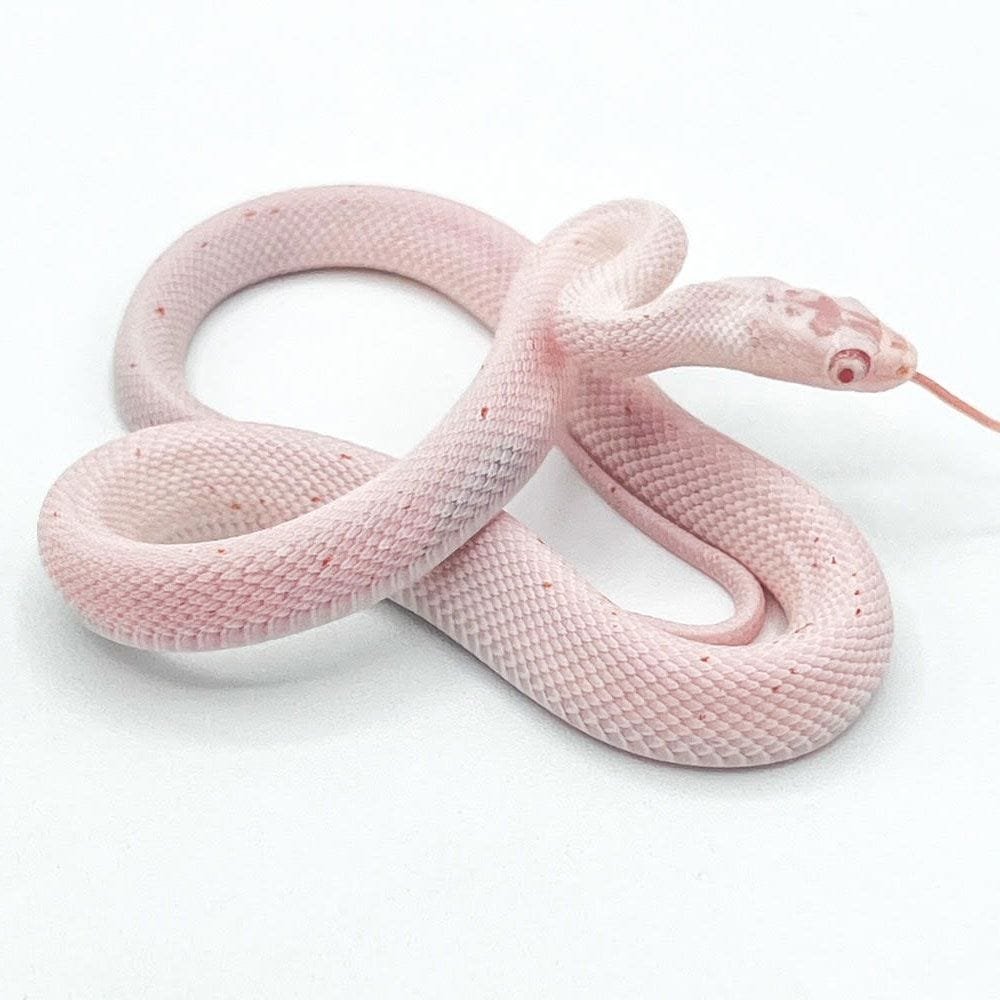
Amel Palmetto Corn snake For Sale
Amel Palmetto Cornsnake
The Amel Palmetto Cornsnake, known for its striking appearance and docile nature, has garnered significant attention among reptile enthusiasts. A unique variant of the common cornsnake.
Palmetto Corn Snake Genetics (Why It Matters)
If you just want a pet, you can skip this section. But if you’ve got any interest in breeding or understanding why palmetto corn snakes cost what they do, pull up a chair.
Incomplete Dominance
Unlike most corn snake morphs (amel, anery, lavender, etc.), which are simple recessive, the palmetto corn snake trait is incomplete dominant. Here’s how it plays out in real life:
- Two copies of the palmetto gene (homozygous / “super” palmetto): You get a visual palmetto—the white snake with speckles we’ve been talking about. Some breeders call this the “super” form, but it’s the standard visual expression.
- One copy of the palmetto gene (heterozygous / het palmetto): You get a snake that doesn’t look like a normal. Het palmetto corn snakes typically have a reduced pattern, lighter background color, and often a noticeable head pattern change. They’re distinctly different from wild-types, which is how we know it’s not a simple recessive.
What’s really fascinating—and I’ve seen this in my own clutches—is that there’s a visible difference between a het palmetto and a wild-type. I can pick the hets out of a mixed clutch by the time they’ve had their first shed. They’re lighter, less defined, almost like someone put a whitewash filter over the pattern. This makes test breeding unnecessary in most cases.
Breeding Outcomes
Let’s say you have a visual palmetto corn snake and you want to breed it. Here’s what I’ve actually gotten from my pairings:
- Palmetto × Normal (wild-type): 100% het palmetto offspring. All visually distinct from normals. None are visual palmetto.
- Palmetto × Het Palmetto: Roughly 50% visual palmetto, 50% het palmetto. This is the bread-and-butter pairing for producing palmetto corn snakes without flooding the gene pool.
- Palmetto × Palmetto: 100% visual palmetto. This is where we sometimes see increased eye issues or kinking. I tend to avoid this pairing unless I’m working with animals I’ve rigorously health-tested over multiple generations.
- Het Palmetto × Het Palmetto: 25% visual palmetto, 50% het palmetto, 25% normal. Useful for outcrossing to other morphs.
Combining with Other Morphs
I’ve spent the last several years crossing palmetto into other lines, and the results are spectacular. A few combos I’ve personally produced or worked with:
- Palmetto Anery: White snake with black and grey speckles. Stunning, ghostly look. No red pigment.
- Palmetto Amel (Albino): White with bright orange, yellow, and red flecks. The eyes can be a strange ruby-black mix. Very striking.
- Palmetto Lavender: Pinkish-white base with purplish-grey speckles. Subtle but beautiful.
- Palmetto Tessera: White snake with a fine, linear pattern of speckles. The tessera stripe influence shows through.
I’ve learned the hard way that some combos amplify the eye issues. Pairing two leucistic-type genes (like palmetto with another white snake line) can be risky. I’m careful about tracking lineage and not doubling up on mutations that might affect development. This is where an experienced breeder is worth their weight in gold—we’ve already made the mistakes so you don’t have to.
Enclosure & Housing
Corn snakes are among the easiest snakes to house, and a palmetto corn snake has the exact same care requirements as any other corn snake morph. Don’t let the price tag make you think they’re delicate—they aren’t. But there are some palmetto-specific considerations I’ll point out.
Hatchling and Juvenile Enclosure
I start my palmetto corn snake babies in 6-quart plastic tubs (roughly 12×8×4 inches) in a rack system. Each tub has a small water dish, a paper towel substrate, and a plastic hide on the warm side. I keep it simple for the first few months because babies are flighty, and a cluttered enclosure actually makes them feel safer.
For a single pet, I recommend a 10-gallon glass terrarium with a secure, locking screen lid. Corn snakes are escape artists, and a palmetto corn snake that costs $600 is not one you want to lose behind the refrigerator. I’ve found a baby corn snake can squeeze through a gap you’d swear was too small for a pencil.
Key hatchling setup points:
- Substrate: Paper towels or unprinted newspaper for quarantine and the first month. After that, aspen shavings or ReptiChip. I avoid sand, cedar, and pine.
- Hides: At least two—one on the warm side, one on the cool side. Tight-fitting so the snake feels secure.
- Water: A small heavy dish. I use ceramic ramekins. Change water daily.
- Climbing: Corn snakes are semi-arboreal, especially as juveniles. A small branch or vine isn’t required, but they’ll use it.
Adult Enclosure
An adult palmetto corn snake needs a 20-gallon long terrarium (30×12×12 inches) at minimum. I personally prefer 40-gallon breeder tanks (36×18×16 inches) for my adult breeders. More floor space means more room for thermoregulation and enrichment.
I’ve kept adult palmetto corn snakes in rack tubs (32-quart or larger) for breeding efficiency, and they do just fine. But for a pet you want to enjoy looking at—and trust me, you want to see this snake—a nice display enclosure is worth it.
Adult enclosure must-haves:
- Secure lid with clips or sliding doors. These snakes push. I’ve found a 4-foot female had wedged herself between the lid and rim of a supposedly escape-proof tank. Clips on all four corners, always.
- Multiple hides. Warm hide, cool hide, and a humid hide for shedding. I use cork bark rounds, black plastic boxes, or DIY tupperware with a hole cut in the lid.
- Substrate: Aspen bedding is my go-to. It holds burrows, is easy to spot-clean, and doesn’t raise humidity too much. For a more naturalistic look, a bioactive mix of organic soil, sand, and leaf litter works beautifully.
- Water bowl: Large enough for soaking, but shallow. Change regularly.
- Decor: Branches, fake plants, cork flats. Corn snakes explore, and a palmetto corn snake’s white body against dark wood looks absolutely gorgeous.
Temperature and Humidity
Corn snakes are forgiving, but I’ve seen too many respiratory infections from keepers who thought “room temperature” was fine. Here’s what I actually maintain:
| Parameter | Target Range |
|---|---|
| Basking surface temp | 85–90°F (measured with a temp gun) |
| Warm side ambient | 80–85°F |
| Cool side ambient | 72–76°F |
| Night temperature drop | Can safely drop to 68–72°F |
| Humidity | 40–60% ambient; 60–70% during shed |
I use an under-tank heat mat on a thermostat for belly heat, which aids digestion. For display enclosures, I’ll add a low-wattage halogen basking bulb on a dimmer during the day. Never use a heat rock—they’re notorious for causing thermal burns, and I’ve treated those scars on rescues.
One palmetto-specific note: Because of their white coloration, they can be slightly more sensitive to UVB if you choose to provide it. I don’t find UVB necessary for corn snakes, but if you use it, make sure there are plenty of shaded hides so your snake can choose full shade. Light-colored morphs can be prone to eye strain under intense lighting.
Diet & Feeding
I’ve raised thousands of corn snakes, and feeding a palmetto corn snake is exactly the same as feeding a normal. They take frozen-thawed mice readily, and in my experience, they’re aggressive feeders once established.
Feeding Schedule
| Age / Size | Prey Type | Frequency |
|---|---|---|
| Hatchling (10–15g) | Pinky mice (1–2g) | Every 5 days |
| Juvenile (15–30g) | 2 pinkies or fuzzy mouse | Every 5–6 days |
| Subadult (30–100g) | Hopper or small adult mouse | Every 7 days |
| Adult (100–300g) | Small to medium adult mouse | Every 7–10 days |
| Large adult (300g+) | Large adult mouse or weaned rat | Every 10–14 days |
I feed frozen-thawed exclusively. Live feeding risks bites and injuries that can be devastating, and a palmetto corn snake’s light color makes wounds more visible. I’ve had a live mouse chew on a snake’s tail before I knew better; I’ll never make that mistake again.
My feeding process: I thaw mice in cold water, then warm them to roughly 100°F with a hairdryer or warm water bath. I offer food on feeding tongs, and most of my palmetto corn snakes strike with satisfying enthusiasm. I feed inside the enclosure to avoid stress—switching to a separate container for feeding is unnecessary and can cause regurgitation.
Water: Always fresh and clean. I’ve noticed my palmetto corn snakes tend to soak more than my other morphs, especially before shed. I don’t know if that’s a palmetto thing or just an individual quirk, but I make sure the water bowl is always full.
Health, Common Problems & Vet Care
I’m going to be straightforward about health issues because palmetto corn snakes, while generally hardy, have a few things worth watching that I’ve encountered firsthand.
The “Bug Eye” Spectrum
As I mentioned, eye conformation varies. Mild prominence is normal and doesn’t affect quality of life. However, I’ve seen a few palmetto corn snakes with eyes so large that the spectacles (the clear scale covering the eye) didn’t shed properly. Retained spectacles can lead to infection and vision damage. If your palmetto has prominent eyes, check after every shed to make sure both eye caps came off cleanly. I’ve had to gently remove stuck caps using a damp cotton swab and a lot of patience, but if you’re not experienced, take your snake to a vet.
Kinking and Spinal Issues
All corn snake morphs can throw kinked hatchlings, but I’ve noticed a slightly higher rate in some palmetto lines, especially from palmetto × palmetto pairings. Kinks range from mild tail kinks (cosmetic) to severe spinal deformities that affect locomotion and quality of life. I euthanize severe kinks and do not sell even mildly kinked animals without full disclosure and a pet-only, no-breeding agreement. It’s an ethical obligation.
When I’m buying a palmetto corn snake, I always ask the breeder about kinking rates in their lines. A breeder who says “never had a single kink” might be lucky or might not be fully transparent. I appreciate honesty.
Respiratory Infections
Corn snakes get respiratory infections when they’re too cold and damp. Signs: open-mouth breathing, bubbles from the nose, wheezing, star-gazing. I caught an RI early in a juvenile palmetto that was in a tub with poor ventilation. I bumped the heat to 85°F on the cool end, added better airflow, and it cleared up. If it hadn’t, a vet visit with antibiotics would have been next.
Mouth Rot (Infectious Stomatitis)
Rare in well-kept animals, but stress, poor hygiene, or injury can cause it. Look for swollen gums, cheesy white material in the mouth, or refusal to eat. I’ve dealt with this in a rescued snake and it required antibiotic injections and a long recovery. Keep enclosures clean.
Mites
I quarantine every new arrival for 90 days, no exceptions. Mites are tiny black dots that congregate around eyes and under scales. I’ve had mites come in on a palmetto corn snake from another breeder’s table at a show, and I spent a month eradicating them with Frontline spray (vet-guided) and complete enclosure disinfections. On a white snake, mites are really obvious—which is both a blessing and a curse.
Regular Vet Care
I don’t take every snake to the vet annually, but I do a visual check of every animal weekly. If I see anything concerning—weight loss, regurgitation, odd lumps—I go. An exotic vet visit with a fecal test can run $75–$150, and more if imaging or medication is needed. Budget for it.
Handling & Temperament
Here’s where the palmetto corn snake really shines. In my experience, they’re every bit as docile and handleable as the nicest normal corn snake, if not more so. I’ve handled my palmetto corn snakes regularly to socialize them, and they’re now some of the calmest animals in my collection. They don’t tend to be jumpy as hatchlings, and they settle down quickly.
A few handling tips I swear by:
- Let them settle in first. Don’t handle a new palmetto corn snake for at least a week after bringing it home, and not until it’s eaten at least twice for you. Stress kills appetites.
- Support the body. Always. I let smaller snakes weave through my fingers; larger ones get a gentle two-handed cradle. Don’t grab or squeeze.
- Keep handling sessions short at first. 5–10 minutes for babies, building up to 15–20 minutes for adults. I’ve had a few palmetto corn snakes that would happily hang out on my arm while I answered emails.
- Wash your hands before and after. They have sensitive chemosensory systems, and I once had a hatchling mistake my mouse-scented finger for food. That tiny bite was more startling than painful.
- Avoid handling during shed. They’re cranky and can’t see well. Give them 48 hours after the blue phase clears before handling.
- Don’t handle after a meal. Wait 48 hours to prevent regurgitation.
Palmetto corn snakes, with their striking white color, are natural showstoppers. I’ve taken mine to educational events and school visits, and they’re always the center of attention. They tend to be very tolerant of gentle handling, which makes them excellent ambassador animals.
Full Cost Breakdown (2026)
The cost of a palmetto corn snake is just the beginning. Here’s what I’ve actually spent.
Purchase Price
| Category | Cost |
|---|---|
| Pet-quality palmetto (mild eye prominence, heavy flecking) | $400–$600 |
| High-quality visual palmetto (clean white, low flecking, good eyes) | $600–$1,200 |
| Palmetto combo morph (anery, amel, lavender, etc.) | $800–$2,500+ |
| Proven breeder adult pair | $1,500–$4,000+ |
Enclosure and Setup
| Item | Cost Range |
|---|---|
| 10-gallon starter kit | $50–$100 |
| 40-gallon breeder tank with lid | $100–$250 |
| Thermostat | $30–$80 |
| Under-tank heat mat | $20–$40 |
| Substrate, hides, water bowl, decor | $40–$100 |
| Temp gun / digital thermometer | $15–$30 |
| Total initial setup | $125–$500 |
Annual Ongoing Costs
| Expense | Annual Estimate |
|---|---|
| Frozen mice (bulk, 1 adult snake) | $100–$200 |
| Substrate replacement | $50–$100 |
| Electricity (heat mat, thermostat) | Minimal, ~$30–$60 |
| Vet checkup / fecal (if needed) | $75–$200 |
| Miscellaneous (replacement bulbs, decor) | $25–$50 |
| Total annual cost | $280–$610 |
Compared to a sulcata tortoise, a palmetto corn snake is an absolute bargain in terms of space and long-term expenses. The main investment is upfront, plus the price of the snake itself if you want a particularly nice specimen.
Breeding Palmetto Corn Snakes (What I’ve Learned)
Breeding palmetto corn snakes is addictive, but it’s not plug-and-play. Here’s a quick crash course from my own breeding logs.
Brumation
I brumate my adult breeders for 8–10 weeks at 55–60°F from November through January. Not everyone does, but I find it increases fertility and synchronizes the group. I stop feeding two weeks before cooling to clear their guts.
Mating and Egg Laying
After warming up in February, I introduce the male to the female’s enclosure. I watch for combat or disinterest. A receptive female will let him court her. A few weeks later, she’ll go into shed, and about 7–10 days after that shed, she lays eggs. I use a nest box with moist vermiculite and sphagnum moss.
Incubation
I incubate at 80–82°F for a roughly 60–65 day incubation. Higher temps can shorten it but may cause deformities. I’ve played with temperature to try to influence speckling density, and I’m not convinced there’s a strong correlation—it’s mostly genetic.
Hatching and Baby Care
Palmetto corn snake babies usually pip around day 55–65. I leave them in the egg to absorb yolk, then set them up individually. I’ve had a few palmetto hatchlings that were slow starters feeding, but with patience, paper bag trick, and sometimes a live pinky head for scenting, they come around.
Ethics of Selling
I sell only well-started babies (at least 5 meals and 2 sheds). I disclose any eye or kink issues. I ask buyers about their setups. I’ve refused sales to unprepared keepers. The palmetto corn snake is too special to be an impulse buy.
Frequently Asked Questions
Q: What is a palmetto corn snake?
It’s a leucistic color morph of the corn snake with a white base and random colored speckles, caused by an incomplete dominant gene first discovered in the wild in South Carolina.
Q: How much does a palmetto corn snake cost?
In 2026, expect to pay $400–$800 for a standard palmetto, and $1,000+ for high-quality or combo morph individuals.
Q: Are palmetto corn snakes good for beginners?
Yes, in terms of care. They have the same forgiving husbandry requirements as any corn snake. However, the initial cost might be high for a first snake.
Q: Do all palmetto corn snakes have bug eyes?
Many do, to varying degrees. It’s a linked trait of the morph. Most are mild and cause no issues, but check with the breeder about eye health.
Q: How big do palmetto corn snakes get?
Adults average 3.5–5 feet. Females tend to be larger. They’re slender, manageable snakes.
Q: What do palmetto corn snakes eat?
Frozen-thawed mice appropriate to their size, on a regular feeding schedule. No live feeding needed.
Q: Can I house two palmetto corn snakes together?
No. Corn snakes are solitary and cohabitation causes stress, competition, and sometimes cannibalism. I’ve seen it go wrong.
Q: How long do palmetto corn snakes live?
With good care, 15–20 years, sometimes longer.
Final Thoughts
The palmetto corn snake is one of those rare morphs that genuinely changed the game. It’s not just another shade of orange or stripe pattern. It’s a whole new canvas, a genetic quirk that produces snakes that look like living abstract paintings. Every time I open a tub and see that white snout with the big dark eyes poking out, I feel a little jolt of the same wonder I felt that first day at the expo.
But I also want you to see the whole picture. I’ve hatched palmetto corn snakes with eye issues that broke my heart. I’ve had to make tough calls about culling and disclosure that keep me up at night. I’ve seen prices fluctuate wildly and watched breeders push out low-quality animals just to cash in on the hype. If you’re going to bring a palmetto into your life, do it with eyes open. Buy from a breeder who answers your questions, who shows you parent photos, and who doesn’t dodge conversations about health.
When you get it right, though? There’s nothing like it. A palmetto corn snake is a living piece of art that eats mice and curls up in your palm. It’s a conversation starter, a breeding project that never stops surprising you, and a pet that will quietly steal your heart one shed at a time.
Do your homework. Set up the enclosure right. Find a breeder you trust. And then, enjoy every speckled, bug-eyed moment.